Two Wards, One Border: Inside the Makeshift Medicine Minsk Pretends Not to See
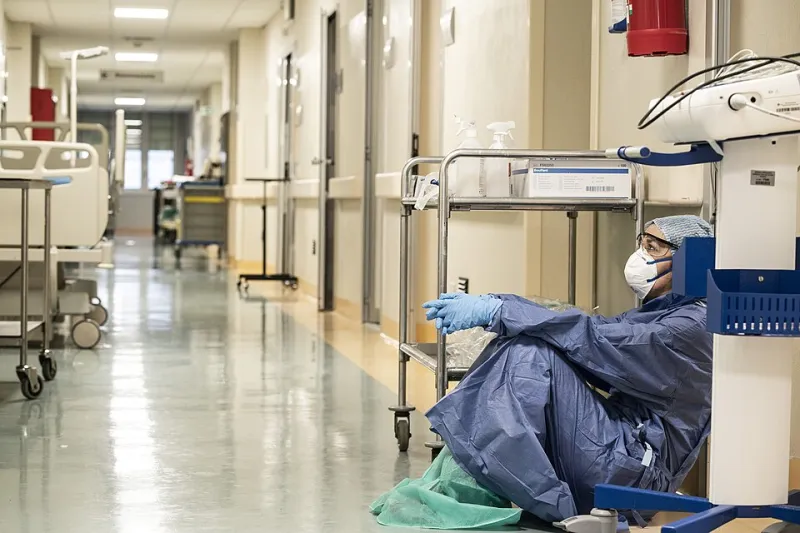
Photo: Alberto Giuliani, CC BY-SA 4.0, via Wikimedia Commons
The emergency department in Pinsk sits about forty miles from the Ukrainian border, close enough that the town's residents heard the first air-raid sirens of February 2022 as a low, confusing hum. In the weeks that followed, according to accounts from medical workers, volunteers, and cross-border fixers, wards in that city and others along the frontier began receiving patients no one officially discussed: wounded men pulled from the fighting, sometimes in uniform, sometimes without one.
Minsk has never acknowledged this traffic. It does not need to. In the strange economy of Belarusian neutrality — a neutrality that hosts Russian missiles while condemning no one by name — the hospitals operate as one of the regime's most useful ambiguities.
The Medicine Nobody Announces
Humanitarian exemptions to sanctions and to the war itself are not unusual. What makes the Belarusian case distinctive is its symmetry. Medical workers, diaspora intermediaries, and regional officials describe a flow that runs in both directions: Ukrainian civilians with shrapnel wounds treated in border facilities, and in some cases Belarusian citizens injured while driving trucks, working rail lines, or living near targets struck by Ukrainian retaliation against Russian launch positions.
This is not the organized field-hospital system Moscow publicizes with ribbon cuttings. It is quieter, more improvised, and almost entirely undocumented in official statistics. Patients arrive through informal channels — ambulance handoffs at crossing points, private vehicles, in at least one reported instance a fishing boat across the Pripyat marshes. Paperwork, where it exists, lists diagnoses that describe mechanism of injury while saying nothing about its cause.
For American readers, the closest analogue might be the Civil War's informal truce lines, where surgeons on either side treated the wounded regardless of color of uniform — an arrangement born less of principle than of proximity and professional obligation.
Neutrality as Cover, and as Constraint
Minsk's official position — that Belarus is not a party to the conflict — depends on plausible deniability in a dozen domains. Medical care is one of them. Treating Ukrainian wounded is defensible under the Geneva Conventions; treating Russian wounded is defensible under the same conventions; treating both, quietly, allows the government to claim humanitarian credentials abroad while avoiding any acknowledgment that there are wounded to treat at all.
The arrangement serves Kyiv's interests too, up to a point. Ukrainian authorities have little appetite for publicizing cases in which their soldiers received care on the territory of a co-belligerent state. And for border communities on both sides, the medical channel is one of the few remaining threads of contact across a frontier that has otherwise been severed.
But the same ambiguity cuts the other way. A hospital that treats everyone answers to no one — least of all to international monitors. Human Rights Watch and Médecins Sans Frontières have documented wartime medical access in Ukraine extensively; Belarus's border wards appear in none of their reports, because access is effectively impossible. The absence of documentation is not evidence of abuse, but it is evidence of opacity.
Where Duty Ends and Complicity Begins
The harder question — one now familiar to American audiences through debates over sanctions carve-outs for food, medicine, and humanitarian goods — is whether the medical channel is a genuine humanitarian corridor or an extension of the war machine it serves.
There is no evidence that Belarusian hospitals are being used to rotate wounded Russian fighters back to the line, as some Russian field facilities have been accused of doing. The scale described by most sources is modest: dozens of patients, not thousands, concentrated in the war's opening months when casualty flows overwhelmed the immediate battlefield. But the same infrastructure that absorbs a wounded farmer today could absorb a convalescing mercenary tomorrow, and the opacity that protects patients also protects whatever else moves through the same channels.
Washington has wrestled with this tension before. The Biden administration's sanctions regime carved out humanitarian space even as it tightened the screws on Minsk's state economy — a recognition, borrowed from decades of Iraq and Syria policy, that collective punishment through hospitals and pharmacies is both morally fraught and strategically counterproductive. The Belarusian medical channel is the living test case for whether that carve-out works as intended.
What the Wards Reveal
Strip away the geopolitics and the picture is simpler: doctors doing what doctors do, in a country where nearly everything else has been conscripted into someone's war. Several of the physicians involved, according to diaspora contacts, are the same professionals who treated protesters beaten in the streets of Minsk in 2020 — a professional class that has learned to operate in the gap between conscience and command.
That gap is where Lukashenko's balancing act lives. The regime supplies Russia's logistics, hosts its troops, and fires across the border in exercises — and simultaneously shelters a medical quiet zone it can point to, should anyone ever ask, as proof of its humanity. Both things are true. Neither is the whole truth.
For US policymakers, the lesson is uncomfortable: neutrality is not a policy but a performance, and the performance can contain genuine good alongside genuine evasion. The wounded in those border wards — whichever side they fought for — are the only participants in this war with no strategy at all. That their survival depends on a system designed to be invisible says more about the conflict than any communiqué from either capital.