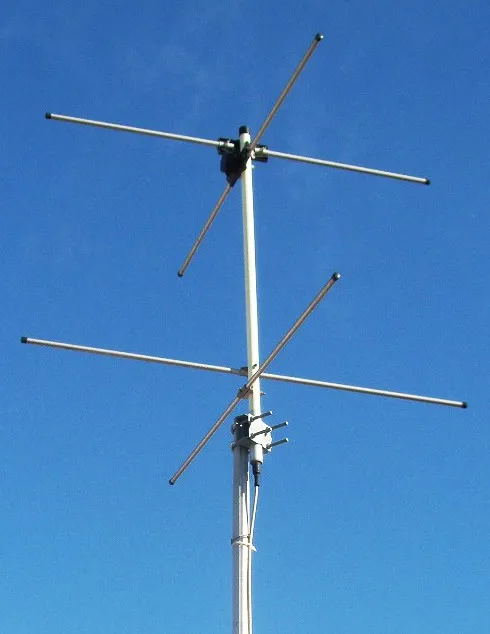
Static That Won't Stay Silent: Inside the Shortwave Web Defying Minsk's Blackout

Photo: Joe Haupt from USA, CC BY-SA 2.0, via Wikimedia Commons
A Technology America Forgot, Belarus Remembered
For most Americans, shortwave radio is a curiosity — the crackle of a Cold War thriller, a hobbyist's garage obsession, maybe a memory of a grandfather tuning Radio Free Europe through the static. In Belarus, it is something else entirely: a weapon.
Since 2020, when President Alexander Lukashenko's government crushed the largest protest movement in the country's history, Minsk has methodically closed nearly every channel of independent communication. Independent websites were blocked. Telegram channels were declared extremist. Border crossings became gauntlets of phone searches. Yet a handful of operators discovered that the one thing Minsk cannot fully jam is the ionosphere itself.
The Anatomy of a Cell
Consider the operations of a communications cell this publication has tracked through exile contacts, security analysts, and intercepted broadcasts — a network whose members refer to themselves by numbers rather than names. What began as 'Signal One,' a retired electrical engineer in the Brest region with a licensed amateur radio setup, has evolved into something far more consequential: a loose relay chain of perhaps a dozen operators stretching from the Polish border toward Gomel.
Their method is deliberately low-tech. Observations of troop movements, rail transfers, and helicopter activity near the Ukrainian border are converted into terse coded transmissions, often broadcast in the evening hours when atmospheric conditions carry signals furthest. Receiving stations — some in Ukraine, some among the Belarusian diaspora in Poland and Lithuania — log the traffic and pass it along. Ukrainian officials have acknowledged, without naming sources, that open-source and human intelligence from inside Belarus has repeatedly flagged Russian logistics activity before formal satellite confirmation.
The cell's members are not soldiers. They are teachers, mechanics, a nurse, a former railway dispatcher. Their motivation, one exile intermediary explained, is less ideology than arithmetic: 'They counted what happened to their neighbors in 2020 and decided silence costs more.'
Why Shortwave Won't Die
There is a reason authoritarian governments keep losing to seventy-year-old technology. Internet traffic can be throttled at the border; VPNs can be identified and blocked; phones can be seized at checkpoints. High-frequency radio requires none of it. A $200 used transceiver, a wire strung between trees, and patience are the entire supply chain.
Belarusian security services are not oblivious. The KGB's successor agency has run periodic 'radio silence' sweeps, and in 2023 authorities amended telecommunications regulations to criminalize unlicensed transmissions with heightened penalties when 'foreign interests' are involved. At least two operators from parallel networks have been sentenced — one to four years — on extremism charges that prosecutors tied to communications with 'foreign structures.'
And yet the cat-and-mouse game favors the mice. Direction-finding equipment is expensive and finite; the territory is not. A transmission lasting ninety seconds from a moving vehicle is nearly impossible to triangulate. The operators have absorbed tradecraft from Ukrainian counterparts and, according to exile coordinators, from tutorials circulating on encrypted channels that read like declassified CIA field manuals.
What It Means for Washington
For US policymakers, the phenomenon cuts in two directions.
First, it validates a lesson the United States learned slowly in the Cold War and nearly forgot: when the information environment is closed, the marginal dollar spent on broadcast and transmission infrastructure — not just digital tools — buys disproportionate access. The Broadcasting Board of Governors' shortwave transmissions to Belarus were curtailed in the 2010s as obsolete. They were anything but. Restoring and modernizing that capacity, including coordination with the existing partisan relay chains, would cost a rounding error in the defense budget.
Second, it raises harder questions. These operators are, functionally, intelligence assets working against a state that treats espionage as treason. Washington has no formal policy on protecting such individuals — no equivalent of the refugee pathways extended to certain Ukrainian cyber volunteers. If one of the numbered operators is caught and sentenced to a penal colony, as others have been, the United States will face the familiar dilemma of whether solidarity extends to people it never officially acknowledged.
The Signal Outlasts the Jammer
There is a quiet poetry to the situation that neither Minsk nor Moscow appears to have fully grasped. The Belarusian state has spent three decades perfecting control of the visible — the streets, the screens, the ballot boxes. Shortwave lives in the invisible: in the weather, in the physics of radio propagation, in the stubborn habit of listening.
Every evening, as the sun sets over the Pripyat marshes and atmospheric conditions shift, the numbered operators switch on. Most transmissions are mundane — a railcar count, a fuel depot's activity, a phrase repeated twice to confirm reception. But each one is a small declaration that the blackout has limits.
Americans once understood this instinctively. It is time to act on that understanding again — before the static, like the voices it carries, is silenced for good.