Rewriting the Neighborhood: How Belarusian Classrooms Became the Newest Front in Minsk's Information War
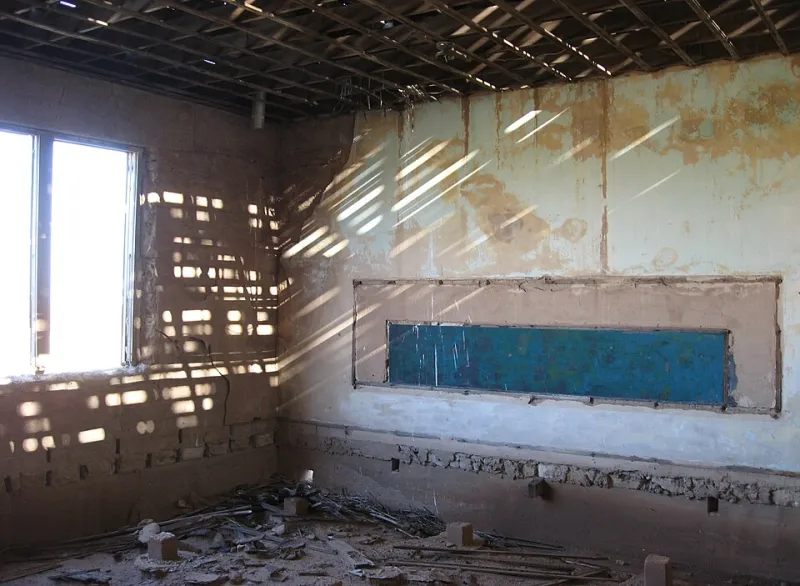
Photo: Wordbuilder, CC BY 3.0, via Wikimedia Commons
Walk into a tenth-grade history classroom in Minsk today, and you will find a version of Ukraine that would be unrecognizable to the historians who wrote Belarusian textbooks a decade ago. The neighbor to the south has been recast — not as a sibling nation with whom Belarus shares medieval roots, but as a wayward territory steered by foreign hands. This is not an accident of pedagogy. It is policy.
A Curriculum Transformed After 2020
The turning point was not February 2022, when Russian forces crossed into Ukraine, but August 2020, when mass protests following a disputed presidential election shook Alexander Lukashenko's grip on power. In the aftermath, the Belarusian state concluded that its greatest vulnerability was not military but generational: young Belarusians, educated in a relatively open information environment, had proven willing to march.
The response has been a systematic tightening of the information space, and the classroom sits at its center. New editions of history and social studies texts emphasize the alleged artificiality of Ukrainian statehood, portray the 2014 Maidan uprising as a Western-engineered coup, and frame Russia's full-scale invasion with careful euphemisms — a "special military operation," borrowed directly from Kremlin vocabulary, that official Minsk insists does not involve Belarusian participation.
Museums have followed suit. Exhibits touching on the medieval polity of Kyivan Rus now stress a lineage running through Moscow rather than Kyiv, a subtle but consequential cartographic claim. State television programming aimed at teenagers echoes the same themes with production values borrowed from streaming-era design.
The Russian Playbook, With Belarusian Characteristics
Analysts who have compared the two countries' educational materials note striking parallels: the denigration of Ukrainian sovereignty, the invocation of NATO encirclement, the celebration of the wartime alliance between Belarusians and Russians against fascism. But there are telling differences. Where Russian textbooks have gone as far as erasing Ukraine from maps, Belarusian materials tend to be more measured — a reflection of Lukashenko's persistent desire to keep a diplomatic exit open.
The distinction matters. Minsk is grooming a generation to be passive, not necessarily to be combatants. The goal, in the words of one exile education specialist, is "a youth that does not ask questions" — a population primed to accept the war as someone else's affair, rather than one stirred to fight in it.
Why This Should Concern Washington
For US policymakers, the temptation is to treat Belarusian textbooks as a curiosity — a small authoritarian state aping its larger patron. That would be a mistake. American strategy toward Belarus has long rested on a wager: that a democratic transition, whenever it comes, will be carried by a young, digitally native, pro-Western generation, the same cohort that filled the streets in 2020. That wager depends on those young people retaining the capacity and the desire to imagine a different future.
An education system that spends a decade teaching teenagers to view their southern neighbor as a puppet state, and Western democracy as a hollow promise, erodes the raw material of that future. Regime change in Minsk — if it happens — would inherit a cohort shaped by wartime propaganda during their most formative years.
There are practical responses. Exile networks already produce supplementary educational content in Belarusian and Russian; modest US support for these efforts, through existing democracy-assistance channels, would cost little. Universities in Poland, Lithuania, and the United States that host Belarusian students on scholarship represent another quiet hedge — every Belarusian student educated abroad is a student the Minsk curriculum did not fully reach.
The Long Game
Wars end with ceasefires; they are settled over decades in classrooms. The border between Belarus and Ukraine has been quiet militarily, but ideologically it is being drawn and redrawn every school year. Whether the next generation of Belarusians sees Ukraine as an enemy to be managed or a partner to be rejoined may be decided not in any negotiation hall, but in the quiet pages of a history textbook printed in Minsk.