A Peace Deal That Ignores Minsk Is a Peace Deal That Fails
Photo: Gwen and James Anderson, CC BY-SA 2.0, via Wikimedia Commons
There is a map circulating in Washington think tanks and European foreign ministries that deserves closer scrutiny than it gets. It sketches possible security guarantees for Ukraine after the war: demilitarized zones, troop ceilings, Western security commitments, perhaps NATO-style assurances short of full membership. Nearly every version of this map has one thing in common. It treats Ukraine's security problem as if it began and ended on the eastern and southern fronts.
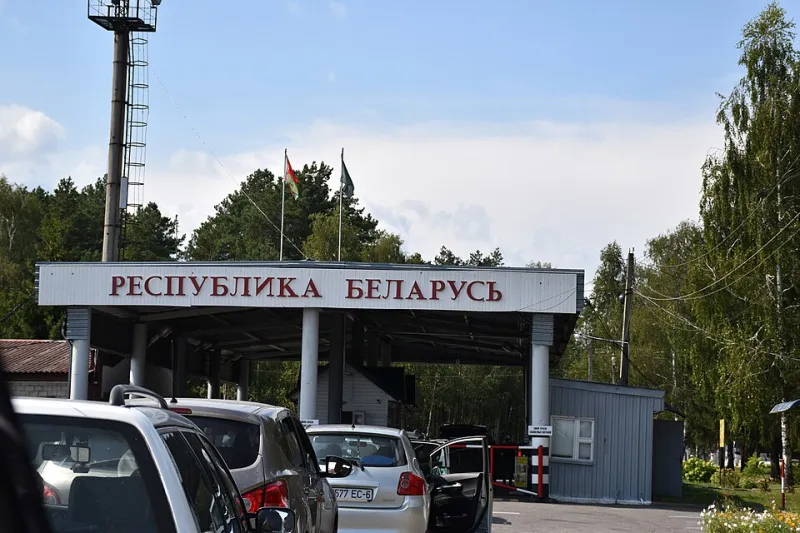
That is a mistake, and a potentially fatal one. Ukraine's northern border with Belarus runs for more than 1,000 kilometers. It was across that border that Russian forces surged toward Kyiv in the opening days of the 2022 invasion, a thrust that failed but came within a few days of changing history. Any settlement that does not answer the Belarus question is not a settlement. It is an intermission.
The 30-Kilometer Problem
Military planners talk about the 30-kilometer line — the zone along Ukraine's northern frontier that Russian forces used as staging ground in 2022. Belarusian territory offered Moscow everything an invasion force needs: rail lines, airfields, assembly areas, and a border undefended by anything more than Ukrainian border guards. The Chernihiv and Kyiv oblasts paid dearly for that geography.
The lesson is simple but inconvenient. Ukraine's security does not depend only on what Russia does. It depends on what Russia is permitted to do from third countries. And since 2020, Belarus has not been a fully independent third country in any meaningful sense. Russian forces are stationed there. Russian aircraft patrol its airspace. Its constitution was amended to abandon the neutrality clause that once, at least on paper, constrained such arrangements.
So what should a serious security framework demand?
What Kyiv and Washington Should Ask Of Minsk
First, verifiable demilitarization of the border zone. Ukraine's negotiators should insist on the withdrawal of Russian forces and infrastructure from a defined belt of Belarusian territory along the frontier, monitored by an international observer mission. This is not fantasy; it has precedents.
Second, transparency on basing. Any peace framework should include declared limits on foreign troop numbers, exercise schedules, and weapons deployments in Belarus, with inspection rights. The 1990 Treaty on Conventional Armed Forces in Europe, however battered, showed that Europe can negotiate such regimes when the political will exists.
Third, a security dimension to any sanctions relief. If Minsk wants a path back to Western markets — and the Belarusian economy, as this site has documented, is now a near-satellite of Russia's — then the price of reintegration should be explicit: no Russian staging grounds, no invasion corridors, no repeat of 2022.
The Precedents Worth Studying
Skeptics will say none of this is realistic while Lukashenko remains in the Kremlin's pocket. Fair enough. But history offers models that seemed unlikely until they happened.
Finland and Norway spent the Cold War as NATO-adjacent states bordering the Soviet Union, bound by treaties of friendship with Moscow yet never hosting Soviet forces or serving as launchpads for aggression. The demilitarized status of the Åland Islands, and the demilitarized zones that survived a century of tension between Finland and the USSR, show that neutral belts can hold even between adversaries.
The Central European states that joined NATO in 1999 were, before accession, required to resolve border questions and minority disputes with neighbors — a discipline that stabilized an entire region. Something analogous, applied to the Belarus-Ukraine frontier, is not utopian. It is statecraft.
The Cost of Omission
Consider the alternative. Suppose a peace deal freezes the line of contact in the east, provides Ukraine with Western security guarantees for its recognized territory, and says nothing about Belarus. Russia retains — or rebuilds — its military footprint a two-day drive from Kyiv. Ukraine must then garrison a second front indefinitely, doubling its defense burden even in peacetime. Every future crisis begins with the same question: will Minsk's territory be used again?
That is not peace. That is a truce with an open flank.
The United States, as the indispensable guarantor of whatever architecture emerges, should make the Belarusian border a first-order negotiating objective, not a footnote. Ukraine's security is indivisible across its geography. A deal that secures the Donbas while leaving the northern gate ajar will be judged, in time, as the deal that wasn't.
The 30-kilometer question will not answer itself. It must be written into the settlement — or it will be settled by the next invasion.