Letters in a Dead Zone: The Clandestine Courier Chain Bridging Belarus and Ukraine
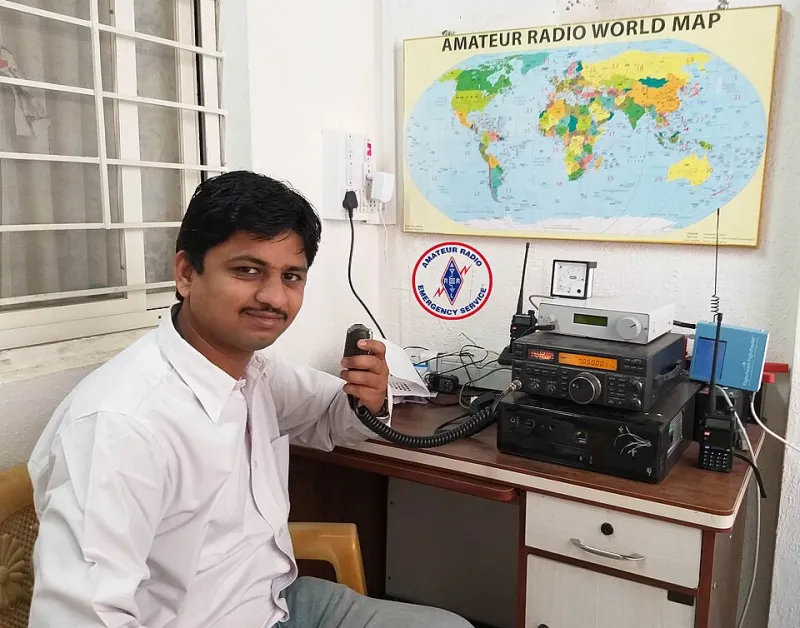
Photo: Rrbhosale, CC BY-SA 4.0, via Wikimedia Commons
There is no postal service between Belarus and Ukraine anymore. There is no roaming, no direct dialing, no bank transfer that clears without a maze of intermediaries. For the hundreds of thousands of people with relatives straddling that border — a Belarusian grandmother in Gomel, a daughter married into a family outside Chernihiv — the war did not just move a front line. It deleted a communication infrastructure that had existed for generations.
What replaced it is not an institution. It is a web of improvised couriers, garage tinkerers, and radio operators who have quietly rebuilt the connection, one smuggled envelope and one bounced shortwave signal at a time.
The Infrastructure of Improvisation
The network has no name, which is the first rule of belonging to it. Its backbone is movement: cross-border traders who once hauled cigarettes and gasoline now carry microSD cards taped inside lighters; Ukrainian women with Belarusian passports shuttle printed letters in the lining of stroller bags; truck drivers on the sanctioned timber routes take payment in cash and in trust.
The cargo is mundane and precious in equal measure. SIM cards still activated on Belarusian carriers are worth their weight in gold on the Ukrainian side, letting a refugee mother hear her father's voice without routing through three VPNs. Printed photographs of grandchildren born in wartime pass westward. Voice memos recorded onto cheap flash drives travel the other way, because a voice message carries something a text never does — the tremor, the laugh, the proof of life.
American readers might picture the Civil War's severed mail routes, or families on either side of the Berlin Wall passing microfilm in coat buttons. The comparison is not decorative. It is roughly the scale of separation involved when a two-hour drive becomes a smuggling operation.
The Radio Underground
Less visible than the couriers, and arguably more ingenious, is the RF layer. Belarus still has a functioning ham radio culture — a holdover from Soviet-era DOSAAF paramilitary hobbyism — and a subset of its licensees have become relay stations for human connection.
The practice is simple in concept and nerve-wracking in execution. A licensed operator in, say, Baranavichy arranges a scheduled contact with a counterpart in Rivne or Volyn. Under the cover of routine hobby traffic, they pass short personal messages using procedural codes and first names only. Encryption is not the point; deniability is. A listener monitoring the band hears two hobbyists comparing antenna conditions, not a mother learning her son survived Kupiansk.
Belarusian authorities have not been asleep. Amateur radio licensing has grown more restrictive since 2022, and equipment imports face new scrutiny. But a decades-old hobby leaves a long paper trail of grandfathered licenses, and confiscating every shortwave set in a country where grandfathers keep them is a heavier lift than the KGB's successors might like to admit.
What the Couriers Risk
The legal exposure is asymmetric and stark. On the Belarusian side, facilitating unauthorized cross-border communication can be prosecuted under statutes covering extremist materials — a category so elastic it has swallowed independent journalism, charity donations, and now, in practice, family correspondence deemed sympathetic to Ukraine. A courier caught with a batch of letters is not facing a smuggling fine. He is facing the extremisim article, and with it, the possibility of years in a colony.
On the Ukrainian side, the risks are different in kind. Border guards screen for Russian infiltration, and a Belarusian passport — even one belonging to a genuine opposition sympathizer — invites hours of interrogation. The couriers accept this. Several of those interviewed for this piece, through intermediaries, described the work in terms that would sound familiar to anyone who has studied wartime civil resistance: not heroism, but arithmetic. The risk is calculable. The alternative — letting the connection die — is not.
Why the Pipeline Matters Beyond the Families
It is tempting to file this story under human interest and move on. That would be a mistake, for two reasons.
First, these networks are among the last functioning channels of unfiltered information flowing into Belarus from Ukraine. State television in Minsk maintains a totalizing narrative of the war; the courier pipelines carry photographs of Bucha, of destroyed Kharkiv, of graves. Every smuggled SD card is a counter-disinformation operation that no Western budget could buy, because it arrives with the one credential propaganda can never fake: a relative's voice.
Second, the networks are a live gauge of Belarusian society's actual relationship to the war. Lukashenko's regime is a co-belligerent in name and a reluctant host in practice. The existence of hundreds of ordinary Belarusians willing to commit crimes of correspondence for Ukrainian families suggests the population's loyalties never followed the flagpole. For US policymakers debating how much agency to attribute to Belarusian civil society in any postwar settlement, that signal is worth reading carefully.
A Thread That Can Be Cut
Nothing about this pipeline is guaranteed to survive. A single high-profile arrest, a crackdown on amateur radio licensing, or a complete closure of the remaining crossing points would degrade it severely. The network's strength — its informality — is also its fragility. There is no redundancy plan because redundancy requires coordination, and coordination requires exposure.
Yet the historical record offers some comfort. Family communication networks have outlasted the Iron Curtain, the Berlin Wall, and every regime that tried to ration human connection. The letters keep moving because someone on each end refuses to let them stop. For now, that refusal — scrawled in pencil, carried in a stroller bag, relayed over a crackling 40-meter band — is the last open channel between Minsk and Kyiv's war-weary hinterland. It deserves more attention than it gets, precisely because it is so easy to overlook.