The Iron Artery: How One Soviet-Era Rail Network Carries the War — and Might Yet Stop It
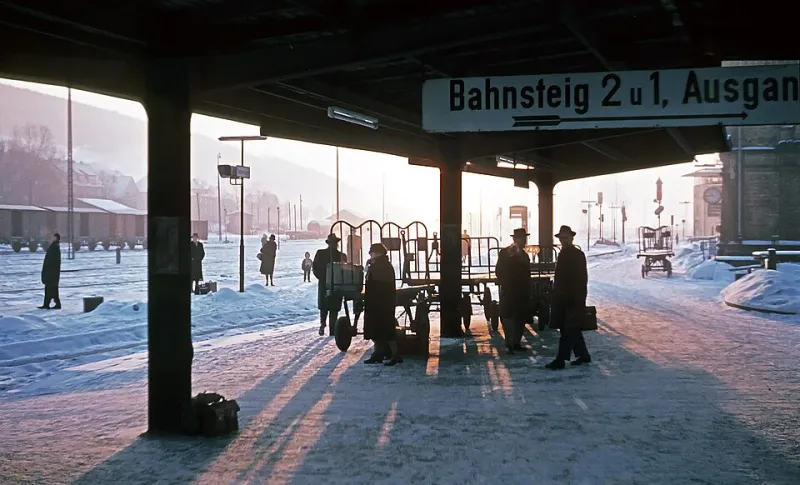
Photo: Michael Gäbler, CC BY 3.0, via Wikimedia Commons
There is a particular irony embedded in the name Belarusian Railway. In Belarusian, the network is still formally known as Belaruskaya chyhunka — and for three years, that artery has pulsed with the machinery of a war Minsk insists it is not fighting. Every T-72 rolled off a flatcar, every Kalibr missile crated in a boxcar, every fuel tanker rumbling south toward the Ukrainian border has traveled on rails that Washington has largely treated as background noise. They shouldn't be.
A Network Built for a Different War
The Belarusian Railway is a Soviet inheritance: roughly 5,500 kilometers of broad-gauge track, engineered in the 20th century to move heavy armor westward against NATO. That legacy is precisely what makes it indispensable today. Russia's military logistics into Ukraine run on two assumptions — that the rails exist, and that they keep functioning. Russian forces are rail-dependent to a degree that would astonish most American planners raised on truck convoys and air bridges. The famous remark attributed to a Prussian chief of staff, that no more than four divisions can be supplied along a single double-track line in a day, might as well be carved above the freight yard at Gomel.
Satellite imagery and open-source investigators have documented the steady southbound flow: missile launchers, artillery shells, repair equipment. This is not Belarusian artillery dueling with Ukrainian gunners. It is Belarusian dispatchers, signal boxes, and locomotive crews enabling someone else's war — a distinction that has allowed Western capitals to avoid the harder question.
The Partisan Problem
Into this picture step the saboteurs. Since 2022, exile-aligned groups — most prominently BYPOL and the self-described Cyber Partisans — have claimed a string of operations: signal relay cabinets set alight in the Homel and Mahiliou regions, switch mechanisms jammed, control cables severed. Their stated logic is blunt. Slow the rails, slow the war.
Belarusian authorities have responded with sweeping treason prosecutions, and verifying each claim is difficult from a distance. But the pattern is credible enough that Ukrainian officials have repeatedly urged the West to support the railway partisan network explicitly. Kyiv understands something Washington has been slower to grasp: a handful of burned relay boxes in February 2022 might have changed the war's opening chapter, when Russian columns stalled outside Kyiv partly because their own logistics could not keep pace.
Lever or Red Line?
For American policymakers, the rail question splits into two camps. The first treats Belarusian rail infrastructure as a strategic lever — a pressure point worth cultivating through cyber support, intelligence sharing, and planning for the day the network itself becomes contested terrain. The second fears escalation: sabotaging infrastructure inside a state that hosts Russian tactical nuclear weapons is, to put it mildly, not a decision to make casually.
Both camps have a point, which is why the honest answer is a third path. The United States does not need to greenlight sabotage operations today. It needs to understand the network the way it understood Yugoslav rail lines in 1999 or Iraqi supply routes in 2003 — as terrain. That means sustained mapping of chokepoints, the rail bridges over the Prypiat tributaries, the junction towns where single-track lines converge. It means quiet channels to the railway workers themselves, thousands of whom have watched their workplace become a war pipeline and resent it. And it means a legal and policy framework decided in advance, not improvised at three in the morning during a crisis.
The Tracks Run Both Ways
The deeper point is this: the same rails that carry Russian weapons south would carry a Russian occupation force, or a Russian withdrawal, in any number of futures. Infrastructure literacy is not escalation. Ignorance is the risk. A Washington that cannot answer basic questions about the Belarusian rail network — who runs it, where it breaks, who might break it — is a Washington negotiating from a blind spot.
The Belarusian Railway was built to serve an empire. Whether it ends up serving the war's continuation, or its conclusion, depends partly on choices not yet made in Washington.