Fertilizer, Flour, and Fingerprints: Following Belarus's Farm Exports Through the Sanctions Maze
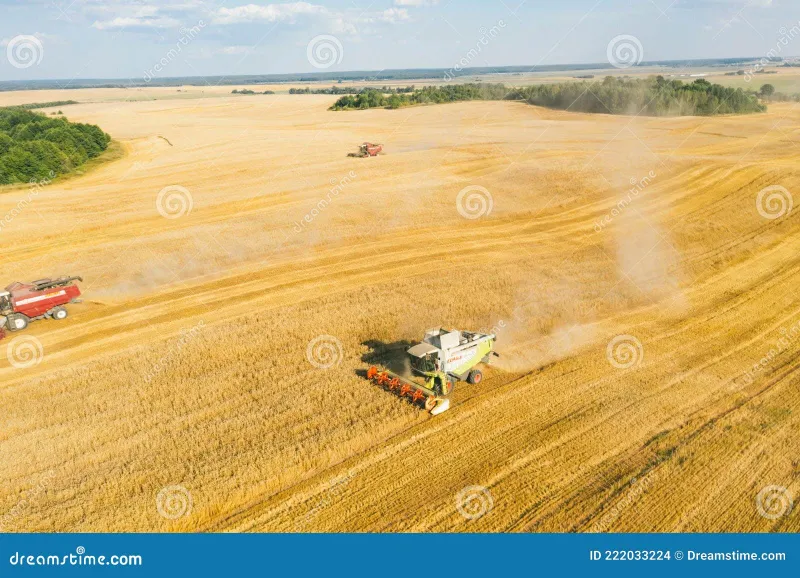
Photo: Belarusian grain harvest combine fertilizer warehouse export, via thumbs.dreamstime.com
When American policymakers discuss sanctions on Belarus, the conversation usually gravitates toward potash, petroleum, and heavy machinery. Rarely does a sack of fertilizer or a pallet of dried milk powder make it into a Senate hearing. That silence may be the point.
Belarus's agricultural sector is not a sleepy backwater of the economy. It is a sprawling web of state-controlled conglomerates — combined dairies, meat processors, grain traders, and chemical producers — that employ hundreds of thousands of people and generate billions in export revenue. Because food is universally treated as a humanitarian good, these enterprises have enjoyed a degree of leniency that other Belarusian industries never received. And therein lies the vulnerability.
The Benign Facade
There is nothing inherently suspicious about a country exporting cheese or chicken. Belarus has genuine comparative advantages in agriculture: fertile soil, Soviet-era infrastructure that still functions, and state coordination that keeps supply chains moving. Food exports were largely spared from the harshest Western designations precisely because targeting groceries reads badly in public diplomacy.
But the structure of the sector is what should concern Washington. Nearly every major agri-business ultimately answers to the Presidential Administration or the Management Affairs Directorate — the same organs that anchor Lukashenko's political machine. Ownership is opaque by design. A dairy exporter in Brest may report to a holding company registered in Minsk, which answers to a ministry, which reports upward. Peeling back the corporate onion reveals that profit does not simply flow to farmers; it flows to the state apparatus that sustains the war next door.
The Shell Game in Practice
Sanctions lawyers describe a familiar pattern. A designated entity cannot ship directly to Western or Western-adjacent markets, so the contract migrates. A newly incorporated trading firm — sometimes in a neighboring jurisdiction, sometimes as distant as the Gulf or Central Asia — signs the purchase agreement. The goods still originate at the same Belarusian processing plant. The money still terminates, eventually, in accounts controlled by the original conglomerate.
Trade data reviewed by analysts tracking the Belarusian economy show agricultural and food-product exports continuing to reach markets in the Middle East, Africa, and Latin America at volumes that predate the war. Some of this is legitimate commerce. But the sheer opacity of the intermediary layer — firms with no website, no employees of record, and registration dates suspiciously close to major sanction rounds — suggests that at least some of this traffic functions as more than trade. It is a liquidity pipeline.
For a US audience, the analogy is straightforward: it resembles the pre-2008 correspondent-banking abuse problem, except the currency is potash-derived fertilizer and milk solids instead of wire transfers.
Why Food Gets a Pass — and Why It Shouldn't Always
The humanitarian exemption is a real principle with real value; starving populations should not be collateral of sanctions policy. But Belarus is not a famine-stricken state. It is a middle-income country whose agricultural exports compete commercially in global markets. Treating every food shipment as untouchable creates an enormous loophole that a sanctioned regime can drive a grain truck through.
There is also the matter of dual-use adjacency. Fertilizer production in Belarus is inseparable from the chemical industry that produces industrial inputs. The same logistics networks — rail spurs, port transshipment points, insurance brokers — that move agricultural goods move sanctioned commodities. Every legitimate shipment helps maintain infrastructure that serves illegitimate ones.
What Washington Can Do
Three steps would meaningfully tighten the net without harming food security anywhere.
First, designate the state holding companies and management organs that sit atop the agri-conglomerates, rather than playing whack-a-mole with individual processing plants. Targeting the apex of the ownership pyramid is more efficient and harder to evade.
Second, require enhanced due diligence from US-adjacent counterparties — including third-country importers who re-export into American markets. The Foreign Economic Evidence framework used against Russian oil price-cap evasion offers a template.
Third, publish the ownership webs. Treasury's and State's sanctions annexes could do far more to map conglomerate structures explicitly, giving compliance officers at American banks and trading houses a fighting chance of spotting the shell entities before the wire clears.
The Stakes for Ukraine
This is not merely a sanctions-compliance story. Every dollar that flows through Belarusian agri-exports strengthens the fiscal resilience of a government that has ceded its territory to Russian forces and facilitated the invasion of Ukraine. Kyiv's western border cannot be secure while Minsk's war chest is quietly refilled by shipments nobody wants to scrutinize.
The agriculture loophole is not the largest channel in Belarus's sanctions-evasion architecture, but it may be the most comfortable one — the channel that hides in plain sight behind images of wheat fields and dairy barns. Closing it will not end the war. Ignoring it, however, guarantees that the financial plumbing underpinning Minsk's alignment with Moscow stays open for business.