Astravets at the Edge: The Nuclear Risk Next Door That Washington Isn't Pricing
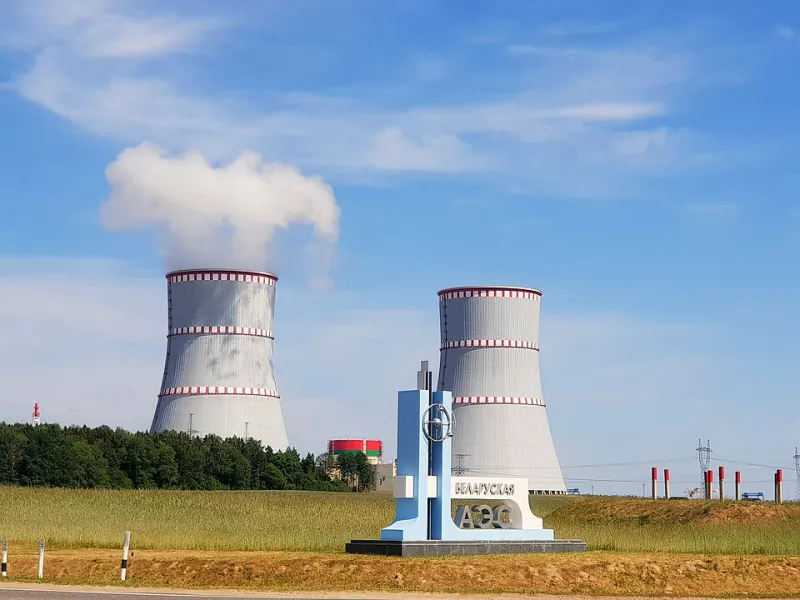
Photo: Tess Mattew, CC BY-SA 4.0, via Wikimedia Commons
Military planners who game out the next phase of the war in Ukraine usually fix their maps on the south: Zaporizhzhia, the Dnipro, the Black Sea. The north gets less attention. That is a mistake, because one of the region's most consequential pieces of infrastructure sits in Belarus, not Ukraine.
The Astravets nuclear power plant, in the Hrodna region near the Lithuanian border, is not a front-line facility. It is a civilian reactor, built with Russian technology and fueled with Russian uranium. But in wartime, civilian and military categories blur. Astravets is close enough to NATO's eastern edge, integrated enough into Russia's grid, and dependent enough on Moscow's supply chain to make it a live variable in any serious regional contingency.
What Astravets Is — and Isn't
Astravets has two Russian-designed VVER-1200 units. The first connected to the grid in 2020, the second in 2023. The plant supplies a large share of Belarus's electricity and is central to Minsk's long-term energy strategy. It is not a weapons facility. Its risks are the ordinary risks of nuclear power — plus the extraordinary risks of geography.
The plant is roughly 30 miles from Vilnius, the Lithuanian capital. It is farther from Ukraine's border, but it sits within the broader northern theater of the war, where Russian and Belarusian military activity has repeatedly raised alarms. Lithuania has been a vocal critic of the project since before it opened, citing safety concerns and the plant's Russian design. Those concerns have not gone away.
The Dependence Problem
Astravets runs on Russian fuel. Its grid links are also tied to the Russian system. That dependence matters in a war that has already turned energy into a weapon. If Moscow wanted to pressure Minsk, it could slow fuel deliveries, interrupt grid flows, or use the plant as leverage in a broader political bargain. None of those scenarios requires a military attack.
A disruption would not automatically mean a radioactive release. Most nuclear safety scenarios involve shutdowns, not meltdowns. But a shutdown is not harmless. It can strain the grid, force emergency measures, and create cross-border confusion. In a region already nervous about the war next door, even a controlled emergency at Astravets would have political consequences.
Four Scenarios That Worry Planners
The first is loss of offsite power. If the grid goes down, the plant relies on diesel generators to keep cooling systems running. Those generators are tested and backed up, but a prolonged outage — caused by cyberattack, sabotage, or military action — is the kind of scenario that keeps nuclear regulators awake.
The second is fuel supply interruption. If Russia restricts fuel deliveries, Belarus would have to scramble for alternatives. The plant's design is Russian, and alternative fuel sources are not plug-and-play. A long interruption could force a shutdown or reduce output, with knock-on effects for the grid.
The third is a cyber incident. Nuclear plants are not immune to digital intrusion, and the war in Ukraine has shown how quickly cyber operations can spill across borders. A successful attack on control systems, or even on the surrounding grid, could trigger a safety response that looks alarming from the outside.
The fourth is a military accident. Astravets is not a target in any obvious sense, but war is full of accidents. A stray drone, a misdirected missile, or a fire near the plant could create a crisis that no one intended. The closer military activity comes to the plant, the higher the risk.
What a Disruption Would Mean
In plain English: a serious disruption at Astravets would not look like a nuclear bomb. It would look like a regional emergency. Evacuation plans would activate. Borders might close. Radiation monitors would spike, or not, and the uncertainty would be its own problem. NATO governments would have to decide whether the event was an accident, an attack, or something in between.
That ambiguity is the real danger. In a war already full of gray-zone tactics, a nuclear incident at a Russian-built plant in Belarus would be hard to attribute and easy to exploit. The United States and its allies should not wait for the event to figure out the response.
What Washington Should Do
First, treat Astravets as critical infrastructure in contingency planning, not as a footnote to the Ukraine war. That means including the plant in regional emergency exercises and sharing relevant satellite and sensor data with allies.
Second, support the International Atomic Energy Agency's work at the plant, including safety reviews and transparency measures. Russia and Belarus have not always welcomed outside scrutiny, but the United States can push for more access through diplomatic channels.
Third, make sure sanctions policy includes carve-outs for nuclear safety and spare parts. The goal is to pressure Minsk, not to degrade the plant's safety systems.
Fourth, plan for the political aftermath. A nuclear incident in Belarus would be a humanitarian crisis and a NATO problem at the same time. The United States should have a playbook ready, not a scramble.
Astravets is not the most likely flashpoint in the war next door. But it is one of the most consequential. Washington should price it in.