Beyond the Footnote: A Plain-English Tour of the Arsenal Minsk Points North
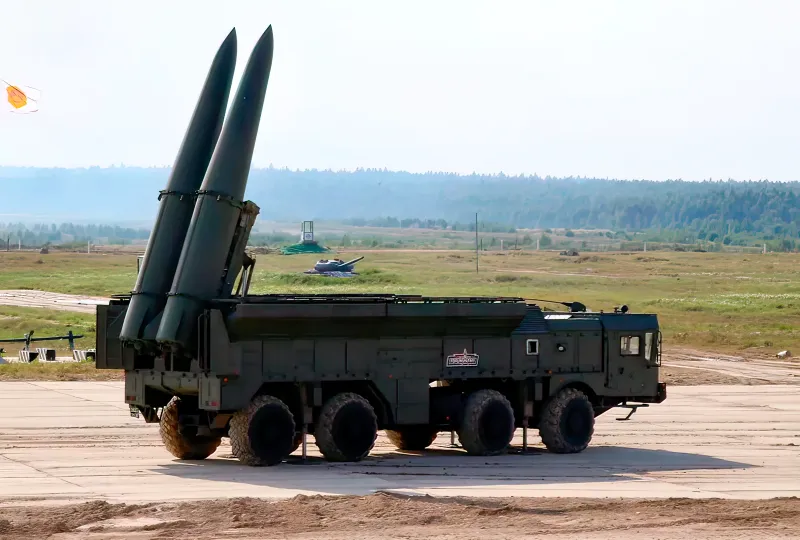
Photo: Belarusian military parade missile launcher Iskander, via israelnoticias.com
For most Americans, Belarus entered the national consciousness in February 2022, when Russian troops poured toward Kyiv from its territory — then faded back into the background noise of the war. That's a mistake. The country of 9 million people bordering Ukraine's north is not merely a staging ground; it is an armed camp in its own right, layered with weapons systems that most US readers have never had explained in plain terms.
Consider this your field guide.
What Minsk Actually Owns
Start with the distinction that shapes everything else: Belarus has its own military, its own procurement, and its own hardware — separate from whatever Russia stations there.
The crown jewel of the domestic arsenal is the Polonez ("Polonaise"), a multiple rocket launcher developed with Chinese assistance and later upgraded into the Polonez-M. Think of it as Belarus's answer to the systems that have dominated headlines in Ukraine: it fires guided rockets out to ranges approaching 300 kilometers, which means, in theory, it could hold Ukrainian cities like Chernihiv at risk from well inside Belarusian territory. Minsk has showcased it in parades with the unmistakable pride of a small state advertising that it built something serious.
Then there is the air force. Belarus operates a fleet of Su-25 attack aircraft — rugged, armored ground-attack jets of Soviet vintage — alongside Su-30SM fighters purchased from Russia in recent years. Neither is cutting-edge by American standards, but both are combat-capable, and the Su-25s in particular are the kind of aircraft that would matter in any cross-border operation.
Rounding out the picture: a sizable inventory of Soviet-era S-300 air defense systems, thousands of armored vehicles inherited from the USSR, and a well-drilled air assault brigade that participated in exercises near the Ukrainian border in the run-up to February 2022.
What Moscow Has Parked There
Now layer on the Russian hardware — because the more consequential weapons in Belarus largely belong to someone else.
The most talked-about are the Iskander-M ballistic missile systems that Russia has transferred to Belarusian units, along with the training to use them. Belarusian President Alexander Lukashenko has openly confirmed their presence. The Iskander is a road-mobile system capable of firing missiles several hundred kilometers, and its arrival fundamentally changed what Minsk's own forces can do. A weapon that once required Russian crews now sits in the hands of Belarusian personnel.
In 2023, Lukashenko announced that Belarus had taken delivery of tactical nuclear weapons from Russia — a claim Washington has never independently verified but has not dismissed. Whether or not actual warheads are on Belarusian soil, the announcement itself marked a threshold: the first time since the Soviet collapse that nuclear weapons were officially positioned in the country.
The airspace tells its own story. Belarusian airfields at Machulishchy and elsewhere have hosted Russian A-50 radar planes and MiG-31K interceptors — the latter modified to launch the Kinzhal hypersonic missile. These are not Belarusian weapons, but Belarusian territory gives them launch positions closer to Ukraine's heartland.
Why the Distinction Matters
Here is the question that keeps NATO's eastern-flank planners up at night: who decides when these weapons are used?
If a Polonez strike or an Iskander launch originated from Belarusian soil, the attribution question would be immediate and explosive. Was it Minsk acting? Moscow acting through Minsk? A false flag? For the United States, the difference matters enormously — Article 5 consultations, sanctions designations, and the shape of any response all hinge on it.
So far, Lukashenko has played a consistent hand: lend territory, refuse to send troops. It is a posture that has kept him in power and out of the war's direct kill chain. But the hardware accumulating in his country narrows the margin between posturing and participation. Every Iskander delivered, every MiG-31 deployment extended, makes the northern front less of a frozen line and more of a loaded one.
The Bottom Line for American Readers
Belarus is best understood not as a footnote but as a fully stocked armory with an ambivalent owner. The Polonez gives Minsk standoff firepower of its own. The Iskanders and possibly nuclear weapons give Russia a forward base it did not have in 2021. And the man in between — Lukashenko — has spent three years demonstrating that the arsenal's trigger finger, so far, belongs to neither.
Watch the northern border accordingly.