License Plates Tell the Story: Tracing Russia's Sanctioned Cars Through Belarusian Parking Lots
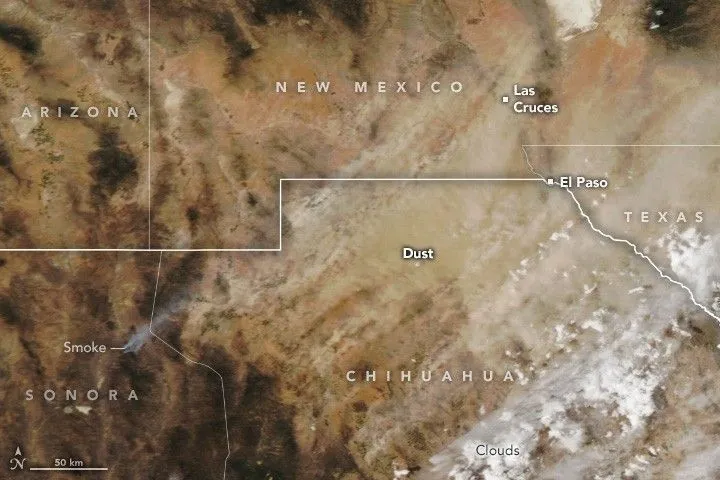
Photo: NASA Earth Observatory image by Wanmei Liang, using MODIS data from NASA EOSDIS LANCE and GIBS/Worldview. Story by Adam Voiland., Public domain, via Wikimedia Commons
A Parking Lot Full of Clues
Drive past the long-term lots near Minsk's airport or the border crossings at Verkhniachka and you'll notice something odd: rows of late-model Toyotas, Volkswagens, and BMWs with Russian plates gathering dust. These are the leftovers of the exodus that followed September 2022, when Vladimir Putin's mobilization decree sent hundreds of thousands of Russians scrambling for the exits — and Belarus, conveniently, was the nearest door.
Most coverage of that moment focused on the men themselves. Fewer people asked about the cars. That was a mistake, because the vehicles tell a story that oil tankers and microchip shipments cannot: how the sanctions regime, designed with industrial leverage in mind, leaks steadily through something as mundane as a used sedan.
The Loophole Was the Purchase Date
Here's the mechanics of it. Western automakers halted exports to Russia in early 2022, and Washington and Brussels banned the sale of vehicles above a certain engine displacement to Russian buyers. But cars already purchased before the bans took effect were legal property. A Russian who bought a used Toyota RAV4 in Yekaterinburg in 2021 could drive it anywhere — including, in theory, back into Europe.
Belarus became the holding pen for that theory. Customs data reviewed by regional analysts suggest tens of thousands of vehicles entered Belarus with Russian owners in late 2022 and 2023. Some owners genuinely emigrated. Many others, it turns out, never intended to stay. Their cars did the traveling for them.
The Gray Market's Second Act
Once inside Belarus, the vehicles entered a shadow economy that Minsk has every incentive not to examine too closely. Some were resold domestically, re-registered through intermediaries who specialize in laundering ownership history. Others were shipped onward — to Kyrgyzstan, Georgia, or the United Arab Emirates — where they re-entered the used-car market with paperwork scrubbed of their Russian interlude.
A smaller but telling stream flowed the other direction: into Ukraine's occupied territories and, via gray importers, into the European Union. Investigators in Poland and Lithuania have documented luxury vehicles with falsified provenance crossing their borders, their Belarusian registration documents masking a Moscow garage history.
For American readers, the analogy is simple. Imagine a sanction on American whiskey exports that didn't apply to bottles already on store shelves, combined with a neighboring country willing to serve as a re-labeling warehouse. The bottle business would boom.
Why Minsk Plays the Pressure Valve
Alexander Lukashenko's government didn't invent this trade, but it has structured itself to profit from it. Belarus charges fees on re-registration, takes a cut of transit logistics, and — most importantly — buys goodwill in Moscow by absorbing economic spillover that would otherwise land on Russian streets.
This is the pattern the United States should recognize. Belarus functions less as a belligerent than as a shock absorber for the Russian economy. Draft evaders pass through. Sanctioned goods are transshipped. Wagner fighters were briefly housed. Each function individually looks minor; together they form a service economy of sanctions relief. The cars are simply the most visible, most countable example — every VIN number is a data point in a ledger Minsk would prefer nobody audit.
What Washington Can Actually Do
There's no clean fix. Secondary sanctions on Belarusian re-registration regimes are blunt instruments that risk pushing even more of the trade underground. But three steps are within reach.
First, expand VIN-based provenance requirements in the EU and among US allies, making it harder for laundered vehicles to re-enter legitimate Western markets. Second, target the specific intermediary firms in Minsk that specialize in ownership laundering — a handful of names, easily sanctioned. Third, treat consumer-goods trafficking with the same analytical seriousness as semiconductor evasion. The Treasury Department's enforcement arms have grown sophisticated at tracking oil shadow fleets; the same toolkit, pointed at used-car flows, would yield a surprisingly detailed map of Belarus's gray economy.
The Bigger Signal
The dust-covered Toyotas in Minsk parking lots are easy to dismiss as a curiosity. They shouldn't be. They demonstrate that sanctions enforcement is only as strong as its weakest neighbor, and that Belarus has made itself indispensable to Moscow precisely by being that weak neighbor — willingly, and for a price.
As the war next door grinds on, American policymakers will face repeated questions about Belarus: is it a combatant, a hostage, or a bystander? The honest answer, written in license plates and resale receipts, is that it is a facilitator — and a facilitator can be deterred only if its facilitation stops paying.